
Compare Chattahoochee Property Values
The 2026 PT-306 notice is the clearest local value record open to inspection. The live qPublic card sits behind a gate. Its printed labels separate prior and current 100% fair-market value. Other value, taxable assessed-value changes, exemptions or credits, and estimated savings each get their own line. Read the label before comparing any two numbers.
| Value | What It Is | Where |
|---|---|---|
| Fair-market value | The assessor's 100% value presentation for the notice year | Board of Assessors notice or card |
| Taxable assessed value | The tax base after the assessment framework and applicable treatment | Assessment notice and assessor records |
| Other or preferential value | A separate value line tied to preferential assessment | Assessment notice and program record |
| Last sale or consideration | The amount stated for a matched recorded transfer, when shown | Clerk deed or transfer record |
Avoid inventing a local ratio. No published dictionary explains the live Chattahoochee card's value fields. The notice, by contrast, lays out the full-value presentation. It also lists separate taxable lines. A recorded consideration reflects a past transaction, never an automatic estimate of today's sale.
Read Chattahoochee Value Columns
The 2026 assessment-notice run went out June 22, 2026. Sample records list owner, mailing address, account or property ID, acreage, tax district, property description, property address, prior and current fair-market values, other value, exemptions, estimated savings, and notice dates. That field set explains a Chattahoochee property value. It is not a full parcel database.
One sample acreage tract carried a separate other-value line and a conservation-use term. Another town-lot record showed age-based and floating statewide exemptions. Each example covers that account only.
Note: Compare value years on the same record, since a prior-year figure and a current-year figure can sit side by side.
Chattahoochee Other Value Explained
"Other Value" is fair-market value for the preferential-assessment portion. Read it with its program, term, and savings fields. Never add it to the ordinary fair-market line without following the notice's own calculation.
Conservation-use entries carry set term dates and estimated savings. They do not prove a recorded restriction, a land-use approval, or a title condition. Ask the Assessor for the program record and the Clerk for any related recorded covenant or deed.
Look Up Chattahoochee Assessed Value
The county links the qPublic site. So does the Georgia Department of Revenue. Its live screens are gated, so search with common parcel keys and keep any result's roll year and disclaimer.
- Search qPublic by the available address, owner, or full account/property ID. If access is gated, contact the Assessor for the card.
- Record the tax year, fair-market line, taxable line, other value, exemptions, acreage, and district exactly as labeled.
- Check the recorded deed for a sale or consideration figure only after the legal description matches.
- Request existing sketches, photos, worksheets, and value-support records when the basis of the assessment matters.
- Assessed value
- A value used in the property-tax framework, read with the exact local label.
- Market value
- The notice's estimate of fair market value, not a guaranteed sale price.
- Assessment ratio
- The relationship between a tax assessment and market value; do not assume a local figure not shown by the source.
- Sale consideration
- The amount tied to a particular recorded transfer.
- Reassessment
- A new official determination for a later assessment cycle.
Chattahoochee Value Access Fallbacks
The Board of Tax Assessors office sits at 215 McNaughton Street and publishes phone and email contacts. Ask by account and year. Parcel cards, sketches, photographs, valuation worksheets, exemption records, and prior notices all exist as office material. An Open Records request can reach existing files. It cannot compel a new appraisal or analysis.
The county's local Tax Assessor page shows the office contact, site-visit notice, address-change direction, and assessment-notice link.
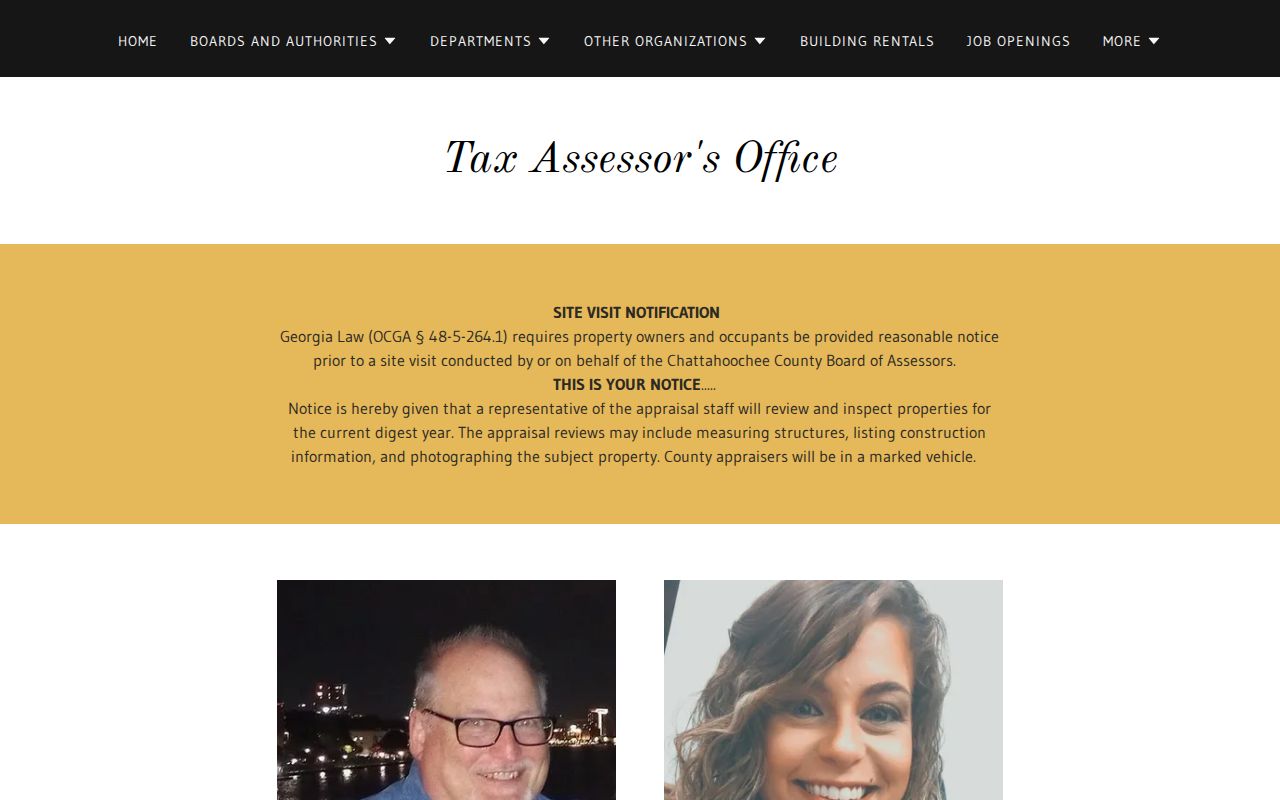
That office page supplies the fallback whenever a live value card stays out of reach through qPublic.
The assessor sets and defends value. The Tax Commissioner handles bills and payments. The Clerk records deeds and related instruments. Keeping those roles apart stops a payment screen or deed price from being mislabeled as the current assessed value.
Cusseta and County Value Districts
Sample notices carry both COUNTY and CUSSETA tax-district labels. Cusseta and Chattahoochee operate as a unified government. The district helps identify a record and its billing context, but it is no title statement or substitute for a jurisdiction map.
A mailing address may point to Marietta or LaGrange while the parcel sits in Chattahoochee County. Compare situs, account ID, district, acreage, and description. The assessor requires written consent for a mailing-address change. That holds when the new address differs from the recorded document. It is one more reason to keep mailing and property addresses apart.
Chattahoochee Sale Price Context
A last sale price belongs to one deed and one date. Search the latest conveyance through the Clerk or GSCCCA. Verify the full legal description, grantor, grantee, recording date, and book and page. A transfer can bundle several parcels or arrive as a gift, an estate, a correction, or another deed type that weakens a simple price comparison.
The statewide index's Chattahoochee window opened January 1, 1970, and its good-through date lags behind the recording desk. A newly recorded sale can fall past that cutoff. An index row is not the instrument image. Pull the deed itself.
Estimated Savings Are Not Value
The PT-306 sample lists estimated tax savings for some exemptions. It also lists them for preferential assessments. The notice builds them on earlier millage. The final bill may differ. Savings are not a refund. They are not a sale estimate, and they are not a reduction comparable to market value.
Questions about the eventual bill belong with the Tax Commissioner. The Chattahoochee property tax records page covers payment and appeal paths. Value interpretation should stop at what each number means. It should also stop at where its source keeps it.
Compare Chattahoochee Value Evidence
A single number from a neighboring parcel rarely settles a uniformity question in Chattahoochee County. Match the year first. Then weigh acreage, land use, district, improvements, condition, exemptions, and any preferential treatment. Only then treat two assessment records as peers. For a formal appeal, request the records the Assessor relied on. That way the comparison rests on an official basis.
The 2026 notice requires value-determination records to be available within ten business days of a request. That is an access guarantee, nothing more. It does not obligate the office to build a custom comparable-sales report. A private appraisal stands as separate evidence if one is needed.
Chattahoochee Property Value Limits
An assessor's figure serves the public assessment process in Chattahoochee County. It proves no title. It fixes no boundary. It certifies no zoning. It promises nothing about what a buyer will pay. A deed price records one past event. A survey and a planning record each answer different questions. Whatever the source, keep the year, the field label, and the parcel number. Keep the retrieval date alongside every value you rely on.
Different decisions demand different proof. A qualified appraiser and current market evidence belong in a sale decision. The recorded deed chain settles title. A survey resolves a disputed line. No single Chattahoochee property value can substitute for those distinct forms of proof.
Value versus price. An assessed value supports taxation. It is not a sale forecast or a licensed appraisal of present market worth.