
Trace Chattahoochee Former Owners
Work backward from the newest grantee. That is the person or entity holding title now. The grantor in each deed points to an older transfer. The chain continues link by link from there. The GSCCCA real-estate name index anchors online deed searches for Chattahoochee County. Pair every index hit with the instrument image. Check its legal description and any reference to a prior deed too. Coverage begins January 1, 1970. It runs through September 3, 2026. That window marks online access only, not the full age of Chattahoochee County land records.
| Source | Years It Covers | Where Held | What It Shows |
|---|---|---|---|
| GSCCCA deed index | January 1, 1970 to the current good-through date | Statewide online index | Grantor, grantee, instrument, dates, and book/page |
| Recorded deed books | Earlier and current volumes | Clerk of Superior Court | Full conveyance and legal description |
| Plat index and plats | Online index observed from January 31, 2004 | GSCCCA and Clerk | Lot, block, subdivision, roads, and dedications |
| County film and tax material | Historic holdings vary by series | Georgia Archives | Older owner, land, estate, and tax clues |
The indexed era is where to start online. When an image is missing, a spelling looks doubtful, or the chain predates 1970, contact the Clerk at 379 Broad Street. Old records call for a different guide. The Georgia Archives County Records Microfilm Index lists surviving series for Chattahoochee County. Trust its county card over any broad statewide date. The official county coverage screen publishes the online date range for the deed index.
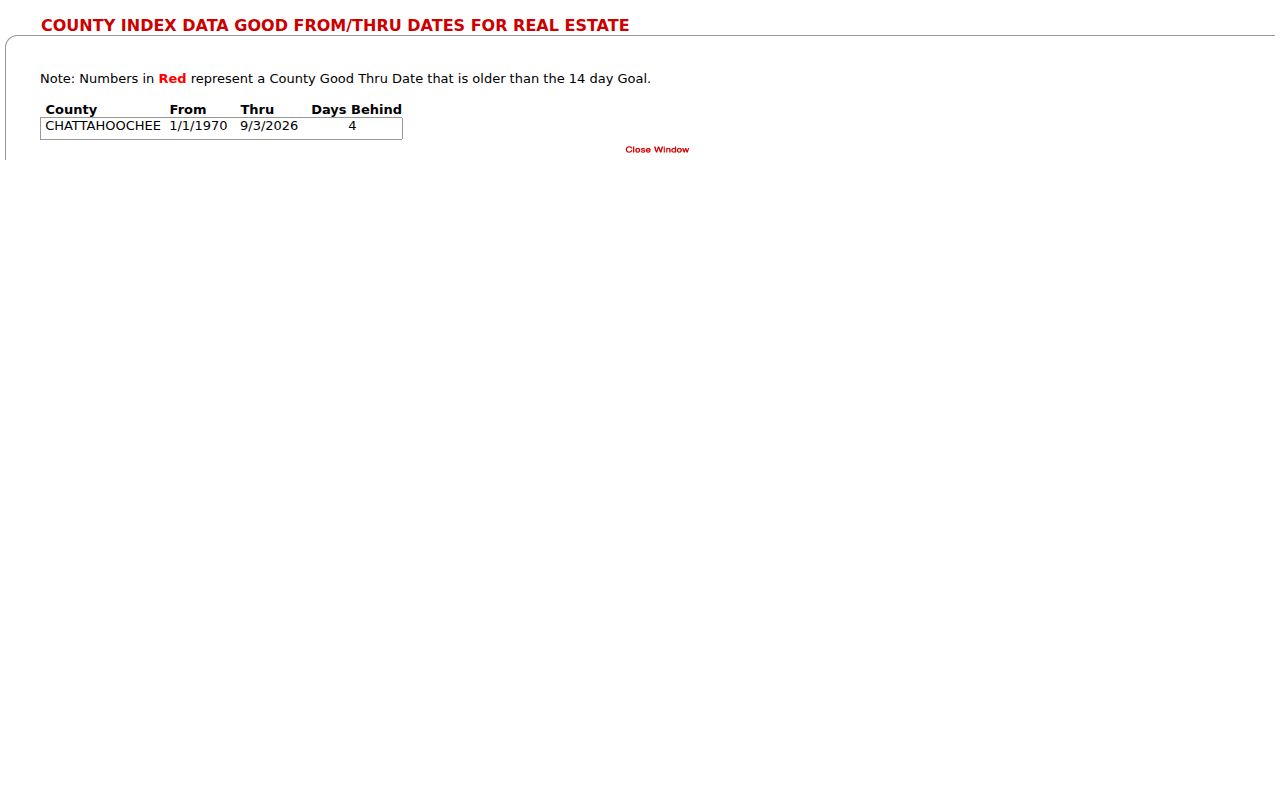
The online cutoff shows plainly in the instrument image. That helps tell a failed name search apart from a record stored in an older book.
Chattahoochee Deed Chain Timeline
Give every located conveyance its own timeline row. Never merge parcels just because one owner name appears on both. An assessment card may describe an acreage tract, a split, or a town lot in shorthand. Only the deed carries the full land language. That language tests whether a chain truly stays on one parcel.
| Transfer date | Grantor to grantee | Instrument | Recorded locator |
|---|---|---|---|
| Newest located transfer | Prior owner to current grantee | Read exact deed type | Book/page or instrument number |
| Earlier acquisition | Earlier grantor to prior owner | Check warranty, quitclaim, gift, or estate deed | Book/page and recording date |
| Parent-tract link | Parent owner to split recipient | Deed, plat, or correction | Referenced prior instrument |
Treat the timeline as a working tool. Quote each source's exact party spelling, and tie every row back to a single legal description.
Chattahoochee Index Stops at 1970
The county good-through page lists a January 1, 1970 start date. It also lists a September 3, 2026 endpoint. A very new filing can therefore lag behind the index by days. Any negative search result deserves a date qualifier for that reason.
Coverage limit. The online deed index begins in 1970; earlier former owners require Clerk deed books, county microfilm, or archive work.
Viewing images may require a GSCCCA account or a fee. A free index summary is just a locator. For a certified copy of one deed, use the Chattahoochee deed records process.
Reverse Chattahoochee Owner Names
Name roles flip as the chain moves back. The newest grantee's deed names a grantor. Search that grantor as a grantee to find the earlier acquisition of the same land. Then repeat the step. Keep initials, punctuation, marital names, trustee labels, and entity suffixes exactly as recorded. A name hit alone proves little. Match acreage, tax district, road, town-lot wording, plat references, and prior deed citations before trusting a link. Same-name parties often hold more than one tract. A correction or re-recording can also mimic a fresh sale while merely fixing an earlier instrument.
Note: Record execution and recording dates in separate fields, since an old signing date can sit under a later index date.
Walk Chattahoochee Deeds Backward
Use the assessor's parcel card only as a modern search key. Ownership history lives in the deed index. When qPublic is down, ask the Tax Assessor for the current card. Preserve the full account ID exactly. Don't try to decode its number blocks.
- Find the latest confirmed grantee and match the deed's land description to the subject tract.
- Record the grantor, deed type, execution date, recording date, and book/page.
- Search that grantor as a grantee, then test the earlier deed against the same parcel clues.
- Repeat until the chain reaches the online cutoff, then continue through Clerk books and archive finding aids.
- Grantor
- The party conveying an interest.
- Grantee
- The party receiving that interest.
- Chain of title
- The ordered series of instruments tied to the same land.
- Reverse index
- An index arranged by the party receiving title, useful for locating an acquisition.
- Warranty and quitclaim
- Different deed forms whose legal effect must be read from the actual instrument.
Chattahoochee Acreage Split Clues
The 2026 assessment notice shows sharply different land descriptions. One account reads “188.54 ACRE TRACT,” another “68 ACRES SPLIT OF 11/18.” A Cusseta account reads “SOUTH 1/2 TOWN LOT #13.” Each phrase demands its own backward search. An acreage split needs the parent deed, the split instrument, and any plat. A town-lot phrase points to old Cusseta plats. Neighboring lot numbers matter there too. A broad acreage tract may rely on metes-and-bounds calls, easements, and prior deed references rather than a street number. Such clues keep former owners attached to the right land through parcel-number changes.
Cusseta Owners Before County Formation
Chattahoochee County was formed in 1854. It was carved from Muscogee and Marion counties. Cusseta town lots were surveyed and sold that same year. A chain reaching that boundary may continue in a parent county rather than simply stop. Later deeds may cite an older parent-county instrument. Search the historic legal description before chasing names across county lines. The old courthouse moved to Westville after its replacement. That is local history rather than evidence of record loss. Claims that county books burned would have no documented basis.
Estate Transfers in Chattahoochee Chains
Some ownership changes never touch a normal sale. A deed-from-estate, gift deed, sheriff's deed, tax-sale deed, or correction instrument can each explain a grantor trail that seems to break. Court orders count too. Probate papers may name heirs, authority, or a representative for the estate. One caution applies. A death record alone transfers nothing. Match the estate or court file to the recorded instrument and its exact land description. Search a trust name or LLC exactly as recorded, and treat the Georgia business database as entity context only; an officer or registered agent is not automatically a former owner of the parcel.
Archive Routes for Prior Owners
Georgia Archives treats deed books and deed indexes as permanent records. Its county film and card catalogs can point you to old deed series. They also cover estate and tax series. Closer to home, the regional genealogy department at Chattahoochee Valley Libraries holds maps and court sources. It also keeps newspapers and FamilySearch Affiliate access. Staff there take research requests. One caveat helps. The library's online indexes lean toward Columbus and Muscogee material. Ask directly about uncatalogued Chattahoochee County holdings. The Cusseta branch offers computers and access. It cannot be assumed to hold the Clerk's current deed books. Recorded conveyances remain the core chain, with archive and tax sources serving as supporting clues.
Limits of Chattahoochee Owner History
How far a Chattahoochee County chain reaches depends on which book series survives. Older indexing quality matters too. So do parcel splits and parent-county history. The online index starts in 1970. That date is certain, but it does not set the age of local deeds. Ask the Clerk which older volume holds a cited book and page, and whether it sits at the counter, travels by mail, or exists on film. Keep every gap visible. Label a missing link honestly, whether it is an unsearched volume, an image-access problem, a name ambiguity, a parent-tract issue, a post-cutoff filing, or no responsive record in the route used. An assumed prior owner is never the answer.
Lawful use. Research former owners for property history, estate work, or purchase diligence. Never use records to track, target, or harass a person.