
Chattahoochee Property Tax Fields
The 2026 PT-306 mass notice lays out the fields the Board of Tax Assessors records before any billing begins. It is the fullest local sample available. The live qPublic card and the Government Window bill both sit behind a login gate, so the mass notice is what a property owner in Chattahoochee County can actually read in full.
| Field | What it shows | Where to verify |
|---|---|---|
| Owner and mailing address | The displayed party and notice destination | Assessor record |
| Account/property ID | The local parcel-account key | Assessor and Tax Commissioner |
| Acreage, district, description | Parcel and billing context | Assessment notice and parcel card |
| Prior/current fair-market value | The assessor's valuation presentation by cycle | Assessment notice |
| Other value and exemptions | Preferential value, programs, and estimated savings | Notice and assessor file |
| Amount due and payment | The actual levy, balance, and receipt trail | Tax Commissioner bill |
A tax district label may read COUNTY or CUSSETA. That tag routes billing questions but does not act as a legal boundary map. A mailing address can also fall outside Chattahoochee County while the land itself stays local.
Chattahoochee Notice Versus Tax Bill
An assessment notice reports the assessor's value decision and opens the appeal window. The property tax bill applies the current levy once that value stands. The notice's estimated tax savings figure relies on prior millage, so treat it as neither a refund, a guaranteed exemption, nor a final charge. The Georgia Department of Revenue sets county tax returns from January 1 through April 1, with December 20 as the general due date unless local rules differ. For the real due date, installments, balance, and payment status, trust only the current Chattahoochee bill.
Look Up Chattahoochee Tax Records
Gather clean identifiers first. Keep situs address, mailing address, account ID, tax district, owner display, and tax year in separate fields. That discipline stops an out-of-county mailing line from masquerading as the land's actual location.
- Open the Chattahoochee qPublic entry and search the property if the live application loads.
- Copy the account ID, owner display, property address, acreage, district, description, values, and exemptions.
- Follow the Government Window property-tax route and complete its captcha when available.
- Match the account and tax year before reading amount due, status, or receipt details.
- If either portal is blocked, contact the Assessor for value records and the Tax Commissioner for the bill and payment trail.
A current bill answers the payment question. A deed answers the recorded ownership question. Neither document substitutes for the other.
Chattahoochee Tax Portal Fallbacks
Government Window's Chattahoochee County section shows a Property Taxes link, Tax Commissioner Judy Liles, and contact details. The tax page itself sits behind a captcha gate, though. Account fields, payment options, receipt controls, and guest-access rules stay out of view there. Plan on calling the Tax Commissioner at 211 McNaughton Street, 706-989-2001, for the current bill and balance. Assessment questions go to the Board of Tax Assessors. Reach them at 215 McNaughton Street, 706-989-3249, or Taxassessor@ugoccc.com. Both offices list 8 a.m. to 5 p.m. hours. Schedules deserve a check before any trip. The local assessor page posts the contact route and links the current notice.
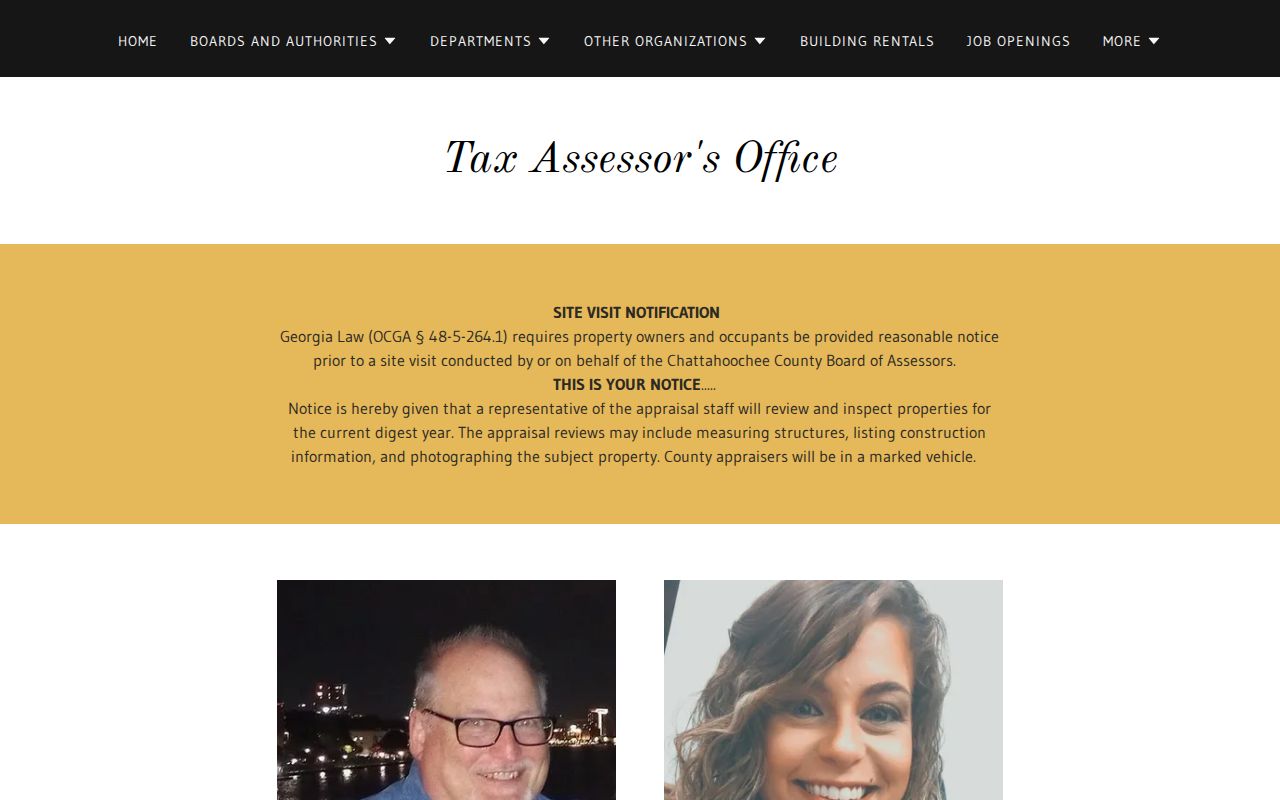
Those contact details give a direct office fallback whenever the parcel or bill interface will not open.
Appeal Chattahoochee Property Tax Value
The 2026 mass notices went out June 22. They set an August 6 appeal deadline, a 45-day window. Those dates belong to that cycle alone. A later owner must read the date printed on the newest notice. That owner should not reuse the old dates. An appeal can target value, uniformity, exemption, taxability, or classification. The notice lists Board of Equalization, arbitration, Hearing Officer, and Superior Court routes. Each route has its own scope. Keep the notice and its envelope. Note the mailed date, deadline, account ID, owner, and both addresses. Also note value columns, other value, exemptions, preferential assessment, tax district, and estimated savings.
Protect the deadline. File within the period printed on the assessment notice, even while requesting the records used to set the value.
Request Chattahoochee Valuation Support
The 2026 notice states that records used to set value must be available within ten business days. The clock starts with a request. Ask early for the existing card, sketch, photo, and valuation worksheet. Include any comparable or classification material tied to the account. Request electronic delivery when practical. Georgia's Open Records Act guidance is tied to O.C.G.A. §50-18-70 et seq. It backs a narrow request for maintained records. Name the custodian, the Chattahoochee County parcel, account ID, date range, and exact record types. The law does not force the office to produce a new appraisal or explain title.
Chattahoochee Exemption Clues
The PT-306 run includes homestead, age-65 or floating statewide exemptions, and conservation-use periods. It also lists preferential value and estimated savings examples. A printed entry hints at the account's treatment for that notice year. Confirm eligibility, renewal, and application steps with the Assessor. The Georgia DOR county tax facts page covers local return, homestead, due-date, and appeal basics. Conservation-use entries reward close reading. The notice can show fair-market value alongside a separate other or preferential value. Never add those columns as one ordinary market figure. The same page's local returns and homestead summary serves as the official procedural reference.
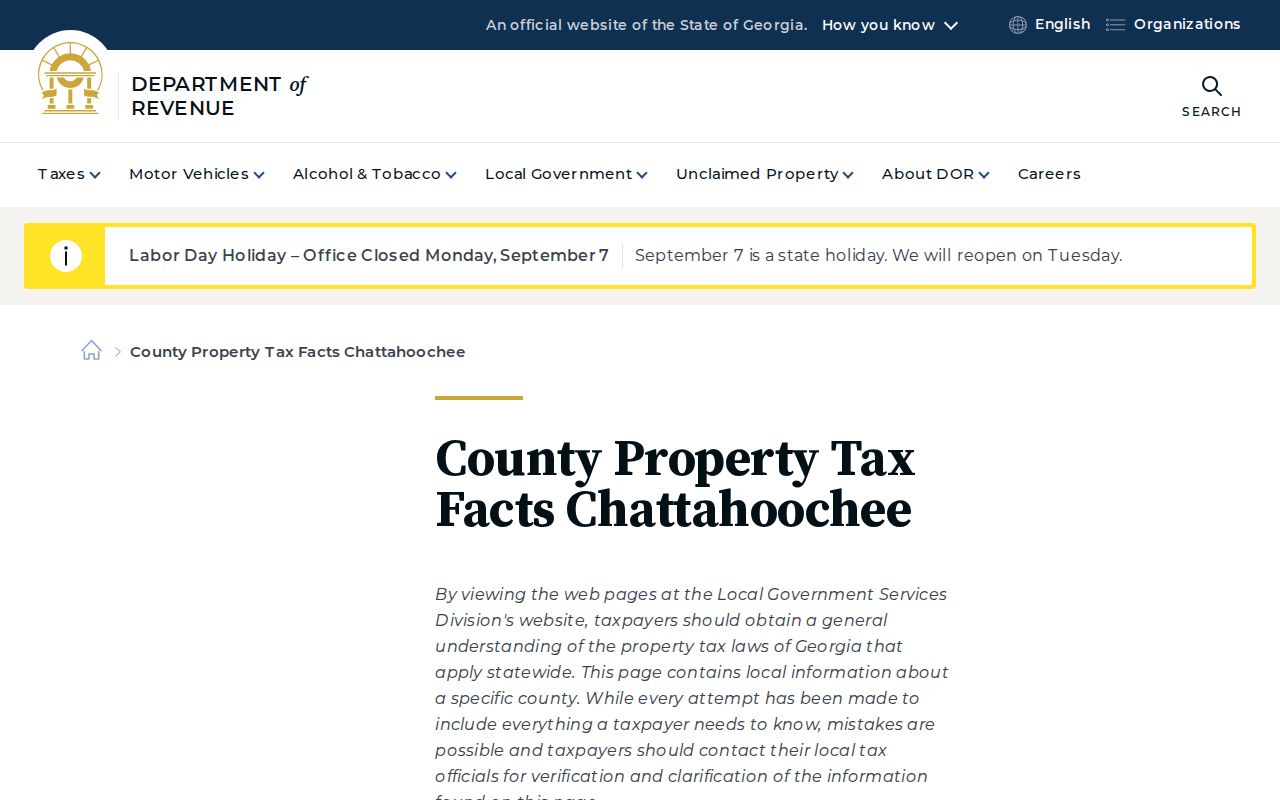
The DOR guidance connects statewide timing rules to the county offices that actually run the assessment and the bill.
Chattahoochee Tax Terms Defined
One parcel can carry several values at once without contradiction. Each label answers a different question.
- Fair-market value
- The assessor's value presentation on the notice, not an appraisal or sale price.
- Assessed or taxable value
- The value used in the tax calculation after applicable rules and exemptions.
- Millage or levy
- The rate applied by taxing authorities to the taxable base.
- Homestead exemption
- A qualifying reduction or treatment that must be confirmed for the account and year.
- Tax lien
- A recorded claim tied to unpaid tax, distinct from a final tax-sale deed.
For a plain-language comparison of assessed, market, and sale figures, rely on the property's valuation record. Keep the bill calculation separate.
Chattahoochee Delinquent Tax Trail
A past-due tax bill starts at the Tax Commissioner's counter. That office holds the bill. It also holds the delinquency notices and the full payment history. Ask there for sale notices and the current redemption status too. If the parcel went to a tax sale, the trail branches. The Clerk's recording side takes over from there. Search the GSCCCA index for the tax-sale deed. Also look for any related liens or releases.
The recorded deed alone settles little. It records the instrument, not the fairness of the process behind it. Recording data matters. So does the cited proceeding. Look for later redemption papers, corrective instruments, or a filed challenge before drawing any conclusion.
Note: The Tax Commissioner confirms the amount owed and the payment trail. The Clerk confirms the recorded instrument trail.
Limits of Chattahoochee Tax Records
Tax records exist for assessment and billing. That is their whole job. They will not prove fee title, a surveyed boundary line, zoning approval, lawful occupancy, or a market sale price. qPublic itself notes that assessment figures reflect the last certified roll, while other data can change.
Route each question to its own record. Title disputes belong with the Clerk's recorded deeds. A line dispute needs a recorded plat and a Georgia-licensed surveyor. Zoning questions go to the Chattahoochee planning files. Keep retrieval dates attached to portal data. A fresh bill or recent transfer may lag behind.
When two years disagree, do not overwrite one with the other. Label the notice year, the certified-roll context, the bill year, the portal retrieval date, and the payment date. That small audit trail shows whether the conflict is normal timing or a record that needs office review.