
Start a Chattahoochee Property Search
Match the tool to the clue in hand. An address or account number leads to the Chattahoochee County Tax Assessor and qPublic entry. An owner name points the other way, toward the Clerk of Superior Court's statewide GSCCCA deed index. A short legal description, like a town lot or an acreage split, may call for both the deed and plat indexes. The tax district and the assessment description can help narrow a match. Neither one establishes title or a legal boundary, though.
Treat these steps as a chain of checks. A parcel card exists for assessment work. A deed index identifies recorded instruments. A tax payment system serves a different purpose, and a plat gives better boundary clues than any tax map. If a screen will not load, note the date and move on to the phone, counter, email, or written-request route. A missing screen is not a missing record.
- Search the assessor route by address, owner, or the exact account/property ID when the local qPublic screen is available.
- Copy the owner label, property address, mailing address, acreage, district, and description as separate fields.
- Search that owner as both grantee and grantor in the GSCCCA real-estate index, limited to Chattahoochee County.
- Check the Tax Commissioner for the current bill and use the recorded plat or deed description for boundary questions.
- Request the instrument image, certified copy, or an office search when the online trail stops.
Chattahoochee Property Record Custodians
Three offices split the core Chattahoochee County property records. The Clerk of Superior Court records deeds, security deeds, liens, plats, and similar instruments. The Board of Tax Assessors sets parcel values. It also maintains the assessment details behind each notice. The Tax Commissioner handles the tax bill, issuing it and collecting payment. Their paperwork overlaps, but their legal duties stay separate. Phone ahead, since hours and contact numbers vary across published local listings.
Clerk of Superior Court
379 Broad Street, P.O. Box 120
Cusseta, GA 31805
706-989-3424
Read the 2026 Notice Fields
The Board of Assessors' 2026 PT-306 notice run is the richest field inventory available for Chattahoochee County property records. The file runs 1,707 pages. Each notice lists the owner name, mailing address, property address, and account or property ID. It also carries acreage, tax district, a short description, prior and current fair-market values, other value, and any exemptions. Estimated savings, the notice date, and the appeal deadline round out the layout. For a parcel number lookup or an appraisal check, these fields mirror what the assessor actually works from.
| Notice field | Best use |
|---|---|
| Account/property ID | Ask the assessor for the matching card and preserve its exact letters and spaces. |
| Owner and mailing address | Identify the displayed taxpayer and where notices go, not who occupies the land. |
| Property address and description | Connect a road, town lot, or acreage clue to the parcel. |
| Tax district | Separate COUNTY and CUSSETA billing context without treating either label as a legal boundary. |
| Value and exemption lines | Read the assessment year and program clues before comparing figures. |
The notices cover rural tracts, entity owners, out-of-county mailing addresses, and Cusseta town-lot language, so those differences work well as search keys in a Chattahoochee County property search. They also show why a name alone is a weak match for the owner of record.
Search Chattahoochee Deed Indexes
The Clerk points visitors to the GSCCCA real-estate name search as the statewide route into deed records. The form is easy to work with. A user picks grantor, grantee, or all parties, then narrows by instrument type, county, neighboring counties, name, and date range. Page size and table display are adjustable too. A grantor gives up an interest in the parcel. A grantee receives it. To trace ownership through the years, search both directions and let the deed chain build itself.
The official name-search page shows those controls up front, with results appearing behind an account login.
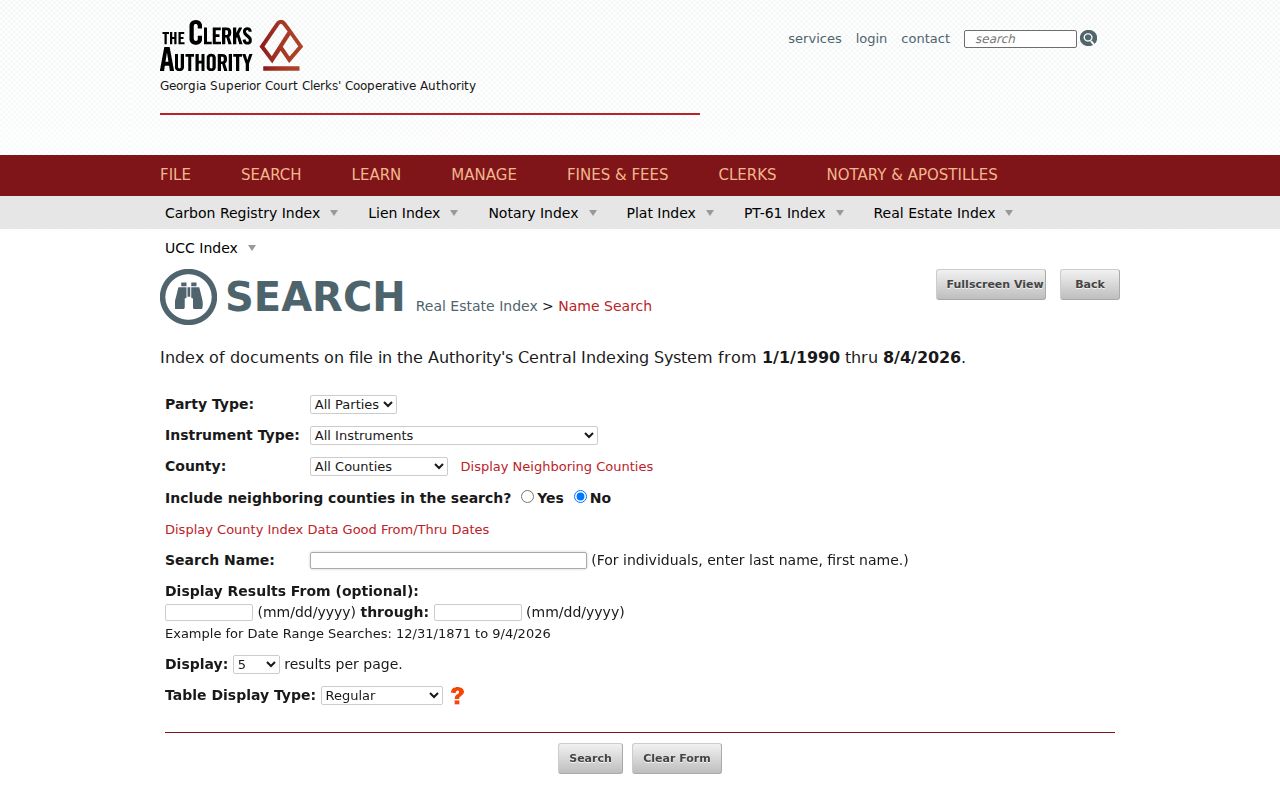
The form makes a focused deed search easy. Filter by county, party role, instrument, and date range before signing in for result images.
| Field | Input | Chattahoochee use |
|---|---|---|
| Party type | All, grantor, or grantee | Trace acquisitions and later transfers separately. |
| Instrument | Deed, lien, release, easement, and more | Narrow a common name to the record sought. |
| County | Chattahoochee | Avoid relying on the statewide date shown on the general screen. |
| Name | Last name, first name; up to 70 characters | Keep entity suffixes and try recorded spelling variants. |
| Date range | Optional mm/dd/yyyy dates | Bracket a sale, split, or court event. |
Chattahoochee County coverage runs from January 1, 1970 through September 3, 2026. An index row is only a pointer. Open the recorded image or order a certified copy before relying on a deed's legal effect.
Chattahoochee Property Record Layers
Chattahoochee County property records work in layers. Recorded deeds capture transfers and legal descriptions. Assessment notices attach an owner of record, address, acreage, district, and value to each tax account. Tax bills from the Tax Commissioner show what was charged and collected. Plats map divisions and lot geometry, and planning files cover land-use requests. The right layer depends on the question you bring to the property search.
| Record Type | What It Documents | Kept By | Access |
|---|---|---|---|
| Deeds and security deeds | Transfers, parties, legal descriptions, and recorded loan interests | Clerk of Superior Court | GSCCCA index, Clerk counter, eCertification |
| Liens and releases | Claims and later cancellations or releases | Clerk of Superior Court | GSCCCA lien/real-estate searches and Clerk |
| Assessment | Owner display, parcel clues, value, exemptions, and district | Board of Tax Assessors | qPublic, annual notice, phone, email, counter |
| Tax bill | Current charge, status, and payment trail | Tax Commissioner | Government Window or office fallback |
| Plats and land use | Recorded divisions, lot clues, zoning requests, and site plans | Clerk and Planning/Zoning | GSCCCA plat index or contact-first request |
Match the record to the question you are asking. A title-chain question belongs with the recorded deed. A balance question belongs with the latest tax bill. Planning approvals tell you about permitted use, never about who holds title, and a business license only names its licensee, who may not own the land at all. The Chattahoochee County deed records route covers the recorded chain, and the remaining layers work best as checks and context around it.
Three Chattahoochee Address Labels
Owner name, mailing address, and property address are three separate fields. Confusing them causes real trouble. The assessor requires an owner to report a mailing change whenever that address differs from the recorded document. The office will not alter it without written consent. So a notice can easily carry a Marietta or LaGrange mailing address while the land, its situs, and its tax district all remain in Chattahoochee County.
- Mailing address
- The place chosen for assessment or tax mail. It does not prove occupancy.
- Property or situs address
- The location label attached to the parcel. A rural tract may show zero, a blank, or only a road.
- Account/property ID
- The assessor's local key. Its segments must not be decoded without an official field guide.
- Tax district
- A billing and classification clue, not a surveyed city line.
Keep each label in its own note. Then match the account number, acreage, district, and short description against a deed or plat. That discipline separates owners who share a name and keeps a mailing address from being mistaken for the property itself.
Cusseta's Unified Record Geography
Cusseta appears as the county's only Census incorporated place. Cusseta and Chattahoochee County share one government. That means planning, zoning, community development, public works, assessment, and tax functions all sit inside the joint structure rather than in separate city offices. Land instruments are different. The Clerk of Superior Court remains recorder for deeds.
Official 2026 notices carry both COUNTY and CUSSETA tax district labels. So search with recorded names and parcel clues county-wide. A Cusseta mailing address can even sit near rural land or Fort Moore. The district label helps route a question. Still, the deed records, plats, and official boundary sources control any deeper location check.
For the city lens alone, see the Cusseta property records page, which covers town lots and planning files best handled by contacting the office first.
Chattahoochee Tax Portal Fallbacks
The county-linked online tax payment route is Government Window. The vendor connects to the Tax Commissioner's office. Anonymous search fields, bill columns, payment methods, and a bill download are not guaranteed features. A gated screen is common. If it blocks a lookup, call or visit the Tax Commissioner. Ask for the bill tied to the exact account or property ID.
Georgia Department of Revenue guidance sets county return filing from January 1 through April 1. Filing runs that window each year. The same guidance gives December 20 as the general bill due date. The county can change it. Those are procedural defaults. They never replace the current Chattahoochee tax bill for any taxpayer. Assessment notices and tax bills must stay separate. A notice's estimated savings line is not a final charge or refund, only an estimate. Have the parcel number ready before calling.
Note: Record the year and retrieval date for every tax document, since the notice, bill, and payment status change on different schedules.
Chattahoochee Plat Cutoff Matters
The GSCCCA plat search covers Chattahoochee County with several entry points. Fields include instrument, county, subdivision or name, Section or GMD, district, land lot, and date. Plat coverage begins January 31, 2004 and runs through September 3, 2026. The deed index reaches back to 1970. That gap matters. An older subdivision or town lot may still require the Clerk or Georgia Archives even when a related deed appears online.
Assessment descriptions offer practical leads. One 2026 entry lists a 188.54-acre tract. Another shows a 68-acre split and a "South 1/2 Town Lot #13." Each calls for a different search. Large acreage may depend on metes and bounds, a boundary described by courses and distances. A split calls for the parent deed and any later plat or division file. A town lot points back to Cusseta's 1854 layout.
Boundary check. A tax parcel line helps orient a search, but only the recorded instruments and a qualified survey can resolve a disputed line.
FANS Watches Future Filings
FANS is the Filing Activity Notification System from GSCCCA. It is free and voluntary. A registrant can enter a name, mailing address, property address, or document-index data. Clerks transmit matching filings later, and FANS sends notice. That adds a watch layer once Chattahoochee County property records have been checked. The FANS registration page shows the name, property, and address paths available for a future alert.
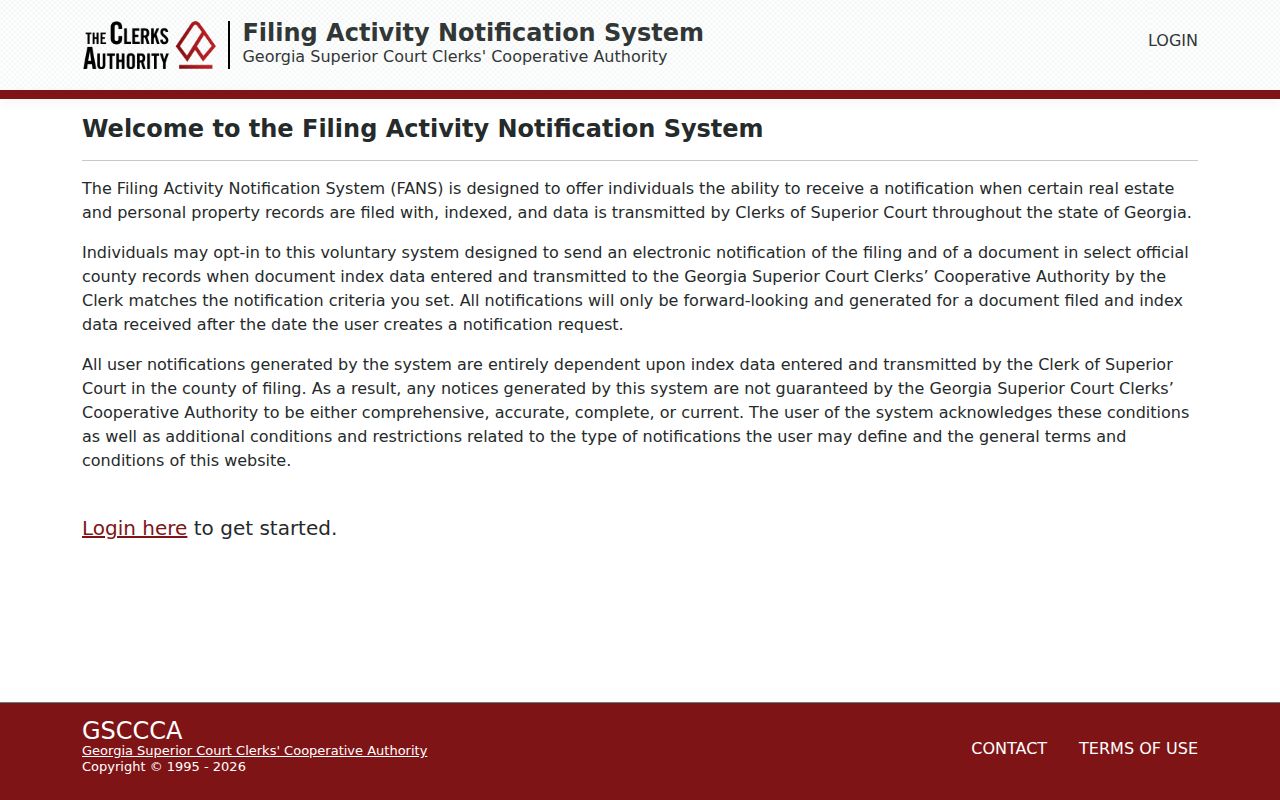
Those choices widen the match options. Every alert still needs checking against the Clerk's recorded instrument. FANS does not search deed history. It cannot prove fraud, guarantee a complete match, or establish title. Its terms also limit misuse. An alert is a cue to inspect the new Clerk index entry and obtain the instrument itself. Silence is not proof that no filing occurred. The best use is future-facing: confirm the current deed first, enter a careful search key, and verify each notice against the county index and legal description.
Older Chattahoochee Land Records
Chattahoochee County dates to 1854. It came from Muscogee and Marion counties. A chain reaching past that creation may move into either parent county. The Georgia Archives County Records Microfilm Index is the first fallback for older deed, tax, probate, and court holdings. Its retention guidance treats deed books and deed indexes as permanent records.
The Archives notes that surviving county deeds and estate materials are often filmed to about 1900. Copied tax material commonly begins around 1872. Those are broad collection guides. They are not confirmed Chattahoochee book ranges. Check the scanned county card before naming a volume. Then ask the Clerk about the physical book or microfilm locator.
Local help exists too. The Chattahoochee Valley Libraries Genealogy and Local History Department offers maps, newspapers, court sources, military material, in-library databases, FamilySearch Affiliate access, and a request service. Its online indexes lean toward Columbus and Muscogee County, so ask about uncatalogued Chattahoochee material rather than assuming none exists.
Fort Moore Changes Parcel Context
Fort Moore, once Fort Benning, covers a huge share of Chattahoochee County, its military land sitting beside rural farm tracts, the Chattahoochee River, and the compact historic Cusseta area. That mix confuses searches. A mailing city or consumer map pin rarely shows which government layer controls a given tract. Local deed and plat records may point one way. Federal, Census, and military boundary sources may point another. Compare them first. Draw conclusions about ownership near the installation only after that.
A county assessment result cannot settle a federal-boundary question, and a military mailing label proves nothing about federal ownership of a parcel. Keep the exact legal description, district label, account ID, and any right-of-way or easement reference intact. The same split breaks address searches. Rural acreage may lack a numbered situs. Historic instruments may name a land lot or a road, and a tract may have passed through government acquisition records.
Request Chattahoochee Records Offline
A missing web result is not a missing record. Email the Assessor at Taxassessor@ugoccc.com for a current property card or account match. Planning and Zoning answers parcel questions too. That office, at shedgecoke@ugoccc.com, holds a parcel's zoning, rezoning, variance, conditional-use, site-plan, or subdivision file. The Clerk handles deeds, plats, liens, and certified copies by index locator.
A written request to the responsible office may invoke the Georgia Open Records Act, O.C.G.A. §50-18-70 et seq., so describe the record, parcel, date span, and preferred electronic format. Ask for estimated cost and any cited exemption. Board Clerk Lisa Bickel leads open records for the unified government. Reach her at 706-989-3602 ext. 1 or Lisa@ugoccc.com.
Counter service still matters. Assessor and planning staff sit at 215 McNaughton Street. The Clerk is at 379 Broad Street. Call first to confirm hours, the right phone line, and current copy fees.
Limits of Chattahoochee Property Records
Chattahoochee County property records answer many questions. They show the name on an assessment, a recorded grantee, stated acreage, a short description, values, exemptions, liens, plats, and land-use requests. They answer less than people hope. No record proves who occupies a property, where a disputed line lies, what zoning approval is current, or what a buyer would pay. Safe at Home and other lawful protections may also shield address data.
Official records beat commercial compilations because the named agency keeps the source document. Still, an index is not the image. A parcel card is not a deed. A map is not a survey. Note the source, year, search fields, coverage cutoff, and retrieval date so anyone can repeat the work.
Lawful use. Use Chattahoochee County property records for lawful due diligence, boundary research, tax review, estate work, and civic oversight. They do not replace a title opinion or survey, and owner data must never be used to stalk, harass, or harm anyone.